

Once you have a list of every printed piece you currently produce, the next step is to evaluate each one with the same lens. The mistake most teams make is judging a piece by how it looks, or how long it has been around. A print audit needs to judge performance.
Here is a practical scorecard you can apply to any brochure, postcard, booklet, folder, flyer, sell sheet, insert, or leave behind. As you review each item, you are trying to answer one question: does this piece reliably help move a real buyer to the next step?
1. Does it have a job, or is it just “nice to have”?
A printed piece should have one clear role in your sales or customer journey. If it does not, it tends to become an expensive habit. The most common “nice to have” pieces are the ones that exist because someone once asked for them, or because a competitor had something similar, or because you had leftover budget at the end of a quarter.
A piece earns “Keep” status when it supports a specific moment, such as: making a first impression, answering common objections, helping a prospect compare options, reinforcing trust after a meeting, or guiding a customer toward a repeat purchase.
If you cannot name the moment it is for, that is your first warning sign.
2. Can you connect it to a measurable outcome?
If a printed piece is worth keeping, you should be able to connect it to at least one of these outcomes:
- It gets a prospect to request a quote or book a consult.
- It shortens the sales cycle because it answers questions ahead of time.
- It improves close rate because it builds trust and clarity.
- It drives repeat purchases because it educates or reminds customers.
- It increases order size by making add-ons obvious.
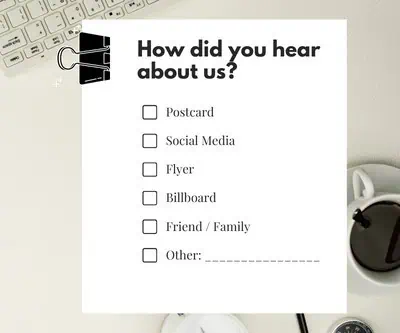
You can track this without turning your collateral into a science project. A dedicated landing page, a QR code tied to a specific piece, a unique phone extension, a simple “how did you hear about us” prompt, or a short URL printed at the bottom can all create accountability.
If you have no way to even estimate impact, the piece may be a brand comfort blanket, not a business tool.
3. Does it speak to your best buyers, or to “everyone”?
One of the most expensive phrases in marketing is, “This applies to anyone.” The more general a printed piece is, the less likely it is to feel relevant to the person holding it.
High-performing print usually does one of two things:
- It speaks directly to a specific buyer type.
- It supports a specific offer.
A generic capability brochure might be fine for a trade show table, but it is rarely the piece that closes a deal. If your printed collateral is still written for a broad audience, the audit may reveal that you need fewer pieces overall, but more targeted pieces that actually do work.
4. Is it current, accurate, and aligned with how you sell today?
Print ages faster than people expect. Services evolve, offers change, pricing shifts, messaging gets refined, leadership changes, logos get refreshed, photos start to feel dated. If you hand someone a printed piece that does not match your website or your current process, it creates friction.
Buyers may not say it out loud, but inconsistency triggers doubt. The audit should identify what is still aligned and what is now quietly hurting you.
A piece that is 80 percent accurate is often worse than having nothing, because it creates questions your team must explain away.
5. Does it reduce confusion, or add to it?
A surprising amount of print exists simply to restate what is already obvious, or to cover too many topics at once. That kind of collateral feels safe internally, but it does not help the buyer.
A “Keep” piece makes decisions easier. It clarifies. It simplifies. It helps the reader understand what to do next.
A “Kill” piece often includes vague statements, too many messages, or an unclear call to action. If a printed piece requires a salesperson to explain it line-by-line, it is probably not carrying its weight.
Common “Kill” Candidates That Show Up in Almost Every Audit
Some items are frequent budget leaks. Not because print is the problem, but because the piece is misaligned with the way people actually buy today.
The everything brochure
This is the classic multi-panel or multi-page piece that tries to represent every service, every industry, every benefit, and every differentiator. It looks impressive, but it often fails to connect with a specific buyer. The result is a piece that goes out in volume but rarely comes back with results.
A better version is usually a smaller set of targeted pieces, each designed to speak to one buyer type or one offer.
The vanity booklet
A glossy, expensive booklet can absolutely earn a “Keep” when it supports high-ticket sales and premium positioning. But many vanity booklets exist without a plan. They are printed once, celebrated, and then slowly become outdated.
If you cannot point to a sales scenario where the booklet consistently helps close, it is likely a “Kill” or “Revise,” even if it is beautiful.
Event leftovers and “just in case” prints
Anything you print for an event should have an afterlife. If it only makes sense for one date, one booth, or one short campaign, you need a plan for what happens to the remainder.
If you have boxes of collateral in storage, that is a signal the piece was not designed for ongoing use.
Pieces that compete with your website
Print should not fight your digital presence. It should work with it. If your printed collateral contains long walls of text that you already have online, it is often a duplication problem. The best print does not try to replicate your website. It does what print is great at: quick clarity, strong visuals, trust reinforcement, and a clean next step.
“Keep” Candidates That Usually Pay for Themselves
On the other side, there are printed pieces that tend to show a reliable return when they are designed intentionally and distributed with purpose.
The leave-behind that mirrors your sales conversation
A strong leave-behind is not a mini website. It is a sales tool. It should anticipate objections, simplify complex decisions, and help the buyer remember what matters after the meeting ends.
If your sales team repeatedly asks for a piece because it makes meetings easier, that is often a “Keep,” as long as it is current and trackable.
The onboarding and expectation-setter packet
Print shines when it reduces uncertainty. A clear onboarding folder, a welcome booklet, a “what happens next” guide, or a care and maintenance guide can reduce churn, prevent misunderstandings, and improve the customer experience.
These pieces often pay for themselves quietly through fewer support calls, smoother projects, and better reviews.
The referral and review driver
A small, well-timed printed piece that asks for a review, encourages a referral, or offers a simple reward can do more than a dozen generic flyers. When print is personal and specific, it feels different than a digital request. It can be the nudge that gets action.
The premium sample kit or proof of quality piece
For categories where texture, finish, photography, or physical quality matters, print can be the difference between “maybe” and “yes.” A smart sample kit is not cheap, but it can be the fastest path to trust.
The audit question is whether it is used strategically with qualified prospects, not whether it is printed at all.
The Third Option: “Revise” Instead of “Keep or Kill”

A “Revise” piece is usually a good idea executed in a way that makes it underperform.
This is where you look for improvements like:
- One clear offer instead of five.
- One buyer persona instead of everyone.
- One next step instead of multiple calls to action.
- Better hierarchy and readability instead of dense copy.
- A trackable path to contact or conversion.
Often, revising a piece reduces print spend because you stop printing bulk quantities of generic collateral and instead print smaller quantities of targeted pieces that actually get used.
How to Run the Audit in the Real World Without Disrupting Your Team
The reason many print audits never happen is that teams assume it will take weeks and involve endless debate. It does not have to.
Start with what you already have. Gather samples, list quantities, record how and where each piece is used, then apply the scorecard. The point is not perfection. The point is to stop spending money on things that do not help.
A strong audit also includes a distribution check. Even a great printed piece fails if it lives in a closet. You need to know whether it is being placed in the right hands, at the right moment, with a clear next step.
If a piece is underperforming, it is either the piece itself, the distribution plan, or both.
The Outcome You Want: Fewer Pieces, Higher Impact
A successful “Keep or Kill” Print Audit usually produces an outcome that surprises people. It does not lead to printing nothing. It leads to printing smarter.
You end up with a tighter set of collateral that reflects how you actually sell, how buyers actually decide, and what your brand wants to be known for. Your team becomes more confident because every piece has a purpose. Your budget becomes easier to defend because print is no longer a line item based on tradition.
And perhaps most importantly, you stop shipping money to the recycling bin.
A Practical Next Step
If you want to do a print audit quickly, start with your top ten printed pieces by either print volume or total cost. Those ten items typically reveal most of the wasted spend and most of the fastest wins.
At RoyerComm, we help teams evaluate what to keep, what to kill, and what to rebuild into something that actually supports sales. If your print closet is full and your results feel unclear, get in touch for a short audit that can turn that into a lean set of collateral that earns its place.