
A lot of businesses try direct mail once, get mediocre results, and conclude it doesn’t work. What they often don’t realize is that their campaign failed not because direct mail is ineffective. It’s actually one of the highest-response marketing channels available. But because it was poorly planned.
Direct mail done right requires the same strategic thinking as any marketing campaign. Get the fundamentals right, and the results can be remarkable. This guide walks you through every step of the process.
Step 1: Define Your Goal and Audience
Every successful direct mail campaign starts with clarity on two questions: What do you want to achieve? And who do you want to reach?
Set a Specific, Measurable Goal
Don’t just mail something because it feels like marketing activity. Define a specific outcome: generate X leads, drive Y in-store visits, acquire Z new customers, retain lapsed customers, announce a new product or location. Your goal shapes everything else… your format, your offer, your copy, your call to action.
Define Your Target Audience
The more precisely you can define who you’re mailing to, the more effective your campaign will be. Consider demographics (age, income, household composition), geography (zip code, radius from your business, neighborhood), psychographics (interests, lifestyle, values), and behavioral data (purchase history, response to previous campaigns, recency/frequency/monetary value).
If you’re mailing to existing customers, you likely already have this data. If you’re reaching out to prospects, you’ll need to acquire or build a list. More on that next.
Step 2: Build or Buy a Quality Mailing List
List quality is the single most important variable in direct mail success. The best design and offer in the world won’t save a campaign sent to the wrong people.
Using Your House List
Your existing customer or prospect database is typically your best performing list. It’s people who already know you, have bought from you, or have expressed interest. Keep your house list clean, current, and segmented so you can target the right people with the right message.
Renting or Purchasing Prospect Lists
If you’re reaching new audiences, you’ll need an external list. List brokers and data providers can supply highly targeted lists segmented by geography, demographics, industry, purchase behavior, and more. Quality varies significantly between providers — ask about data freshness, source, and deliverability guarantees.
Every Door Direct Mail (EDDM)
If your target audience is geographic (anyone who lives or works in a specific area) USPS Every Door Direct Mail is an affordable option. EDDM lets you saturate a postal route without purchasing individual address lists, and it’s particularly effective for local businesses like restaurants, retailers, home services, and healthcare practices.
Step 3: Choose Your Format
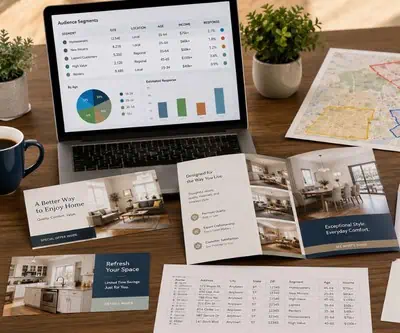
The format of your mail piece significantly affects cost, impact, and response rate. Common options include:
Postcards
Postcards are the workhorse of direct mail. They’re affordable to print and mail, they don’t require the recipient to open anything (your message is instantly visible), and they work extremely well for simple offers, announcements, and reminders. Standard postcards qualify for First-Class or USPS Marketing Mail rates, and oversized postcards command more attention.
Self-Mailers
Folded pieces that mail without an envelope like a tri-fold brochure, for example. Self-mailers offer more space for messaging than postcards and can be very cost-effective.
Enveloped Packages
A letter or brochure inside an envelope can feel more personal and is often appropriate for higher-value offers, financial services communications, or B2B outreach. The envelope itself becomes a creative opportunity… a compelling teaser line on the outside can significantly improve open rates.
Dimensional Mail
A box, tube, or unusual package that stands out dramatically in a stack of flat mail. Dimensional mail has the highest cost-per-piece but also the highest open rates and is particularly effective in B2B campaigns targeting high-value prospects.
Catalogs
For retailers and wholesalers, printed catalogs remain one of the most powerful direct mail formats, driving both online and in-store sales. Studies consistently show that catalog recipients purchase more and at higher average order values than non-recipients.
Step 4: Create Compelling Direct Mail Creative
Your creative (the design and copy of your mail piece) determines whether the recipient engages with it or throws it away. Here are the critical elements:
A Strong Headline
You have approximately two seconds to capture attention before a mail piece gets tossed. Your headline must instantly communicate a benefit or intrigue the reader enough to keep going. Lead with what’s in it for them — not your company name or a generic greeting.
A Single, Clear Offer
Direct mail creative fails most often when it tries to communicate too many things. Pick your single most compelling offer and build the piece around it. Complexity kills response.
Benefits, Not Features
Customers don’t buy features, they buy outcomes. Don’t just describe what you offer; explain what it will do for them. Focus on the result, the transformation, the problem solved.
Urgency and Scarcity
Response rates increase significantly when there’s a reason to act now. Limited-time offers, expiration dates, limited quantities, and early-bird pricing all create urgency that motivates faster response.
A Clear, Prominent Call to Action
Tell the reader exactly what to do: call this number, visit this URL, scan this QR code, bring this mailer in for your discount. Make the CTA impossible to miss. Use contrasting color, a button, a box, whatever it takes to make it stand out.
Professional Design
Quality matters. A mail piece that looks cheap or amateurish signals a cheap, amateurish company. Invest in professional design that reflects your brand and communicates credibility.
Step 5: Print Your Direct Mail Pieces
Once creative is approved, it’s time to go to print. A few considerations:
Choose the Right Paper and Finish
Paper stock affects how recipients perceive your brand. Heavier stocks feel premium. A gloss coating makes colors pop; a matte or soft-touch finish is elegant and tactile. If you’re printing postcards, use heavy cardstock. It survives the mail stream better and feels more substantial.
Work with a Direct Mail Specialist
Not all printers are experienced with direct mail. A printer that specializes in direct mail (like RoyerComm) will understand postal regulations, bleed and safe zone requirements for mail pieces, and how to set up files that will print and mail correctly.
Variable Data Printing
If your campaign includes personalization (names, personalized offers, different messages for different segments) variable data printing (VDP) allows you to print customized content on each piece while running everything through a single print pass. This is a powerful capability that has been shown to improve response rates significantly.
Step 6: Handle Addressing and Postage
Direct mail requires compliance with USPS standards for addressing, formatting, and postage. Working with a printer or mail service provider that offers full mailing services (addressing, NCOA (National Change of Address) processing, barcoding, sorting, and metering) simplifies this significantly and can reduce postage costs through presort discounts.
Make sure your mailing list goes through NCOA processing before each campaign to remove addresses of people who have moved. Mailing to outdated addresses wastes money and inflates costs.
Step 7: Track and Measure Results
Direct mail is more measurable than many people assume. Use these tracking mechanisms:
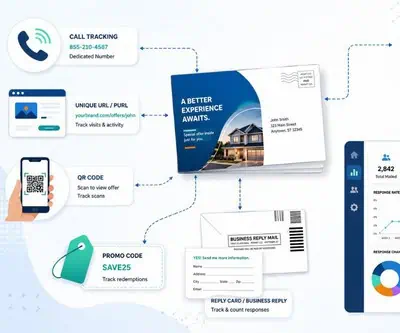
Dedicated phone numbers (trackable call tracking numbers). Unique URLs or personalized landing pages (PURLs). QR codes that link to tracked landing pages. Promo or coupon codes trackable at redemption. Reply cards or BREs (Business Reply Envelopes). Match-back analysis by comparing your mail list against purchase records after the campaign.
Establish your tracking infrastructure before you mail, not after. Document your baseline response rates and costs so you can measure improvement over subsequent campaigns.
Step 8: Follow Up and Iterate
A single direct mail drop is rarely enough to judge a campaign’s potential. The most successful programs mail consistently (typically monthly or quarterly) and build familiarity and capture recipients at the right moment in their buying cycle. After each campaign, analyze results, identify what worked and what didn’t, and refine for the next round.
Also consider integrating direct mail with digital channels. A strategy called “mail + digital” that consistently outperforms either channel alone. Retarget mail recipients with online ads. Follow up a digital campaign with a physical mailer. Create a coordinated experience across touchpoints.
Common Direct Mail Mistakes to Avoid
Over-complicating the message. Targeting too broadly. Using a low-quality mailing list. Skimping on design and print quality. Failing to include a clear call to action. Sending just one mailing and drawing conclusions. Not tracking results. Forgetting to test different offers, headlines, formats, or lists. Each element can be tested and optimized over time.
RoyerComm: End-to-End Direct Mail Services
At RoyerComm, we handle every step of the direct mail process from strategy and planning, creative development, printing, list procurement and processing, and full-service mailing. We’ve helped businesses across industries run campaigns that generate real, measurable results.
You focus on running your business. We’ll make sure your message reaches the right people, in the right format, at the right time.
Frequently Asked Questions: Direct Mail Campaign Planning
How much does a direct mail campaign cost?
Costs vary based on format, quantity, print specs, and postage class. As a rough reference, a postcard campaign including printing and postage might run $0.50–$1.50 per piece at volume. Request a quote with your specific details for accurate pricing.
How far in advance should I plan a direct mail campaign?
For a well-executed campaign, plan for 4–6 weeks from creative approval to mail drop. Rush options are sometimes available, but they typically cost more and leave less room for error.
What postage class should I use for direct mail?
First-Class Mail delivers faster (2–5 days) and is ideal for time-sensitive offers. USPS Marketing Mail (formerly Standard Mail) is cheaper but takes longer (3–10 days). EDDM has its own postage structure. A good mail service provider will help you choose the right class for your campaign.
Can I personalize direct mail pieces?
Yes… and you should! Personalized direct mail consistently outperforms generic mail. Variable data printing allows you to personalize names, offers, messaging, and even images on each piece without significantly increasing production costs.
How many pieces should I mail?
This depends on your goals, budget, and the size of your target audience. In general, larger quantities produce more total responses, but the key metric is cost-per-response and cost-per-acquisition. Start with a test mailing if you’re unsure, measure your results, and scale what works.
Do I need a designer for direct mail?
Professional design dramatically improves response rates. If you don’t have an in-house designer, work with a printer like RoyerComm that offers design services — it’s an investment that pays for itself in better campaign performance.
Start Building Your Direct Mail Campaign Today
A well-planned direct mail campaign can be one of the most cost-effective marketing investments your business makes. The key is doing it right. Starting with strategy, investing in quality creative and print, targeting carefully, and measuring what you send.
RoyerComm is ready to be your direct mail partner from strategy to delivery. Contact us today to get started.
Request a Quote | Call 800.605.7693 ext. 11