

Start With One Trade Show Marketing Strategy
One of the easiest ways for trade show marketing to feel disconnected is to order everything separately.
The booth backdrop comes from one vendor. Someone orders pens online. The marketing team prints brochures. Sales creates a handout. Then, a few days before the show, someone realizes the table needs signage.
The result may technically be a complete booth, but it does not necessarily feel like one campaign.
Instead, start by identifying:
- Your primary audience
- The main problem you solve for that audience
- Your most important trade show message
- The action you want attendees to take
- What materials your sales team needs to support conversations
- How you plan to follow up after the event
Once those decisions are made, your trade show displays, printed collateral, branded giveaways, lead generation materials, and post-event marketing can all reinforce the same strategy.
1. Booth Graphics That Explain Who You Are Quickly
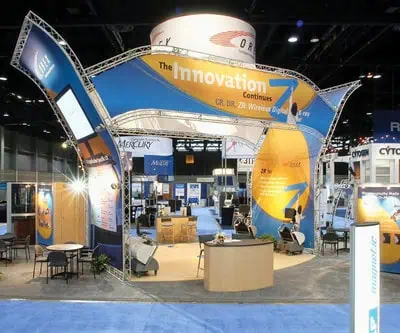
Your exhibit graphics are often the first interaction someone has with your company.
That means your trade show backdrop, display panels, pop-up displays, hanging graphics, and large-format signage should answer a basic question almost immediately:
Why should I stop here?
Trade show floors are crowded. Attendees are walking past dozens or even hundreds of exhibitors. Your booth graphics need to communicate quickly from a distance.
Avoid treating a booth wall like an oversized brochure.
Focus instead on:
- A strong headline
- Clear branding
- One primary value proposition
- Easy-to-understand imagery
- A simple call to action
Large-format printing can create the visual anchor for the entire trade show presence, but the messaging should carry naturally into every other item in the marketing kit.
2. Retractable Banners for Flexible Messaging
Retractable banner stands are one of the most useful components of a trade show display because they can serve several purposes.
You might use one to promote:
- A specific product
- A new service
- A show special
- A QR code
- A product demonstration
- A case study
- An event-specific offer
They can also help define different areas within a larger booth.
Unlike a permanent booth backdrop, retractable banners are relatively easy to reposition and reuse at conferences, recruiting events, sales meetings, open houses, presentations, and other corporate events.
If your company attends multiple trade shows each year, modular display graphics can also make it easier to update messaging without replacing an entire exhibit.
3. Branded Table Throws and Tabletop Graphics
The table is easy to overlook, but it occupies a significant amount of visual space inside many trade show booths.
A professionally branded table throw helps create a polished, cohesive presentation and gives you another opportunity to reinforce your logo and visual identity.
The tabletop itself can then become part of the customer experience.
Depending on the event, you might include:
- Tabletop signs
- Product samples
- Counter cards
- QR code displays
- Brochure holders
- Sample kits
- Appointment cards
- Promotional products
The goal is not to cover every available inch with marketing material. Give each piece a reason to be there.
4. Handouts That Support the Sales Conversation
Printed trade show collateral still matters, but every attendee does not necessarily need the same brochure.
Consider creating a small collection of sales materials for different conversations.
That might include:
Sell Sheets
A one-page sell sheet can quickly explain a particular product, service, capability, or solution.
Brochures
Brochures work well when prospects need a broader overview of your organization or several related services.
Case Studies
A concise printed case study can help a prospect understand how you have solved a similar problem for another organization.
Product Sheets
For technical products or complex services, product sheets can provide specifications and details that would be difficult to communicate verbally during a short booth conversation.
Presentation Folders
A branded presentation folder can combine several pieces into a customized sales kit for highly qualified prospects.
Digital printing and short-run printing make it possible to produce smaller quantities of targeted materials rather than printing thousands of identical brochures for every attendee.

5. Promotional Products People Actually Want to Keep
Trade show giveaways have practically become an industry of their own.
That does not mean you need to buy whatever promotional item happens to be popular this year.
The best branded promotional products have some connection to your audience, your business, or the event.
Useful promotional items might include:
- Drinkware
- Tote bags
- Notebooks
- Pens
- Tech accessories
- Desk accessories
- Apparel
- Product-related tools
- Custom kits
Think about longevity.
A giveaway that gets used for six months creates far more brand exposure than something that gets thrown away before the attendee leaves the convention center.
Promotional products can also become part of your lead generation strategy. A premium giveaway, for example, could be reserved for attendees who schedule a consultation, request a demonstration, or provide their contact information.
6. Materials That Make Lead Capture Easier
Trade shows should generate conversations, but ultimately those conversations need to become identifiable sales opportunities.
Your booth materials can help.
Consider including printed lead capture materials such as:
- Appointment cards
- Product-interest checklists
- Qualification cards
- Consultation request cards
- QR codes linked to forms
- Sample request cards
- Event-specific offer cards
Even if your primary lead capture system is digital, printed materials can help booth representatives guide prospects toward the correct next step.
QR codes can be particularly effective when they lead to a purpose-built destination.
Instead of directing every attendee to your homepage, consider linking to:
- A trade show landing page
- A product demonstration
- A consultation form
- A downloadable guide
- A sample request
- An event promotion
- A case study
- A video
- A scheduling page
The physical and digital experience should work together.
7. Create Different Materials for Different Prospects
Not every visitor to your booth deserves the same packet.
Someone casually browsing might receive a small handout.
Someone evaluating your product might need a detailed sell sheet.
A qualified decision maker may leave with a presentation folder, product samples, case studies, or a customized sales kit.
This is where short-run digital printing can be particularly valuable.
Instead of producing one generic brochure, marketers can develop targeted versions for different:
- Industries
- Buyer personas
- Products
- Geographic markets
- Customer types
- Stages of the buying process
Personalized trade show collateral can make a sales conversation feel significantly more relevant.
8. Do Not Forget What Happens Before the Trade Show
Your trade show marketing kit can start working before anyone walks onto the show floor.
Pre-show marketing can help drive target prospects directly to your booth.
Consider sending attendees or high-value accounts:
- Postcards
- Invitations
- Personalized letters
- Dimensional mailers
- VIP invitations
- Product samples
- Appointment reminders
Direct mail can be particularly effective when targeting a smaller list of priority accounts.
Instead of hoping someone happens to discover your booth, invite the prospects you most want to meet.
Include your booth number, a clear reason to visit, and an incentive or specific action whenever appropriate.
9. Plan Your Post-Show Follow-Up Before the Event Starts
This may be the most overlooked piece of a trade show marketing campaign.
Companies spend weeks preparing for an event and then return home with hundreds of leads without a clear follow-up plan.
Before the show begins, decide what happens after it ends.
Your post-trade-show follow-up campaign could include:
- Personalized postcards
- Thank-you cards
- Sales letters
- Product samples
- Printed case studies
- Dimensional mailers
- Promotional packages
- Email campaigns
- Sales calls
The strongest strategy often combines digital follow-up with physical mail.
An email may arrive immediately after the event, while a printed piece arrives a few days later and brings your company back to the prospect’s attention.
For particularly valuable prospects, a customized direct mail package can turn a brief trade show conversation into a much more memorable follow-up.
10. Build a Reusable Trade Show Marketing System
Companies that attend several events each year should think beyond a single show.
Many trade show materials can be designed as modular assets.
Your core kit might include:
- Reusable booth graphics
- Branded table throws
- Retractable banners
- Generic company brochures
- Product-specific inserts
- Promotional items
- Lead capture materials
- Shipping and packing materials
Then, individual events can receive customized materials such as:
- Event-specific banners
- Targeted handouts
- Show offers
- Personalized direct mail
- Updated product sheets
This approach can make trade show planning faster while also maintaining brand consistency from one event to another.
For companies with multiple locations, sales representatives, or frequent events, a web-to-print marketing portal can also help centralize approved artwork and branded materials so teams can order what they need while maintaining brand standards.
Think of Your Trade Show Kit as a Customer Journey
Ultimately, the most useful way to plan trade show marketing materials is to think about the attendee’s entire experience.
From across the aisle:
They see your large-format booth graphics and signage.
As they approach:
A banner or display communicates a more specific benefit.
During the conversation:
Your sales representative uses a sell sheet, sample, brochure, or case study.
Before they leave:
They receive a useful promotional item or targeted takeaway.
After the trade show:
Your sales team follows up digitally while a direct mail piece reinforces the conversation.
That is much more powerful than simply designing a good-looking booth.
One Partner Can Make the Entire Campaign Easier
Coordinating a trade show involves enough moving pieces without managing a different production partner for every item.
RoyerComm provides commercial printing and marketing production capabilities that can support multiple components of a trade show campaign, including large-format printing, trade show displays, digital and offset printing, promotional products, finishing, mailing, and fulfillment.
Bringing those elements together can also make it easier to maintain consistent colors, branding, production quality, and timing across the entire campaign.
Whether you are preparing for one major industry conference or managing a full calendar of events, think beyond the booth.
Build a complete trade show marketing kit that attracts attention before the conversation, supports your team during the event, and keeps selling after everyone goes home.
Frequently Asked Questions About Trade Show Marketing Kits
What should be included in a trade show marketing kit?
A complete trade show marketing kit may include booth graphics, retractable banners, table throws, tabletop signs, brochures, sell sheets, case studies, product samples, promotional products, lead capture materials, QR code signage, presentation folders, pre-show mailers, and post-show direct mail.
What printed materials work best for trade shows?
The best trade show print materials depend on the audience and sales process. Common options include brochures, sell sheets, product sheets, presentation folders, postcards, case studies, appointment cards, and targeted handouts. Materials should be concise, useful, and connected to a clear call to action.
Are promotional products effective at trade shows?
Promotional products can be effective when they are useful, relevant to the audience, and consistent with the brand. Items that attendees continue using after the event can provide ongoing brand exposure and help prospects remember the company.
How can businesses generate more leads from a trade show?
Businesses can improve trade show lead generation by using clear booth messaging, targeted sales collateral, event-specific offers, QR codes, appointment requests, product demonstrations, lead qualification materials, and a defined follow-up process.
Should trade show marketing begin before the event?
Yes. Pre-show direct mail, invitations, appointment campaigns, personalized outreach, and dimensional mailers can encourage high-value prospects to visit a specific booth rather than relying solely on walk-by traffic.
How should companies follow up with trade show leads?
Trade show follow-up can include email, phone outreach, personalized postcards, thank-you cards, sales letters, product samples, case studies, and dimensional mail. Combining digital communication with physical direct mail can create additional touchpoints after the event.
Can trade show displays be reused?
Many trade show displays can be designed for reuse. Modular booth graphics, retractable banners, table throws, and evergreen company signage can be used across multiple events, while smaller event-specific graphics and printed materials can be replaced as messaging changes.
What is the benefit of using one vendor for trade show printing and promotional materials?
Using one production partner can simplify project management and help maintain consistency across booth graphics, signage, printed collateral, promotional products, and mailing campaigns. It can also make scheduling, production, fulfillment, and brand quality easier to coordinate.
Get in touch with our team today to discuss how we can elevate your brand’s presence and impact at your next trade show!