

Why Printed Marketing Gets Complicated Across Multiple Locations
Distributed organizations naturally create marketing challenges because responsibility is spread across many people.
Corporate marketing may establish the brand standards, but individual locations often handle day-to-day marketing needs.
Without a centralized process, several problems can develop.
Locations may use outdated logos or messaging. Employees may modify marketing templates in ways that do not follow brand guidelines. Teams may order unnecessary quantities of brochures or promotional materials. Different vendors may reproduce colors, paper stocks and graphics inconsistently.
Even simple changes can cause problems.
A salesperson might download an old PDF from a shared folder. A franchise owner could create a flyer using an outdated promotion. A department might send a brochure to a local printer without realizing that a newer corporate version exists.
Over time, these small inconsistencies create brand fragmentation.
A centralized print management program gives organizations a way to maintain control while still making materials easily accessible.
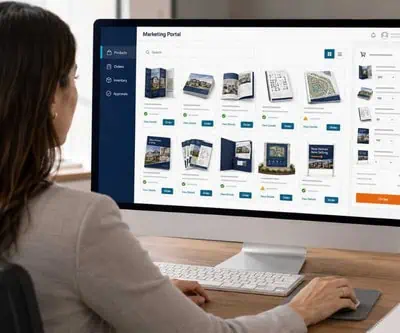
Centralize Approved Marketing Materials
One of the simplest ways to improve brand consistency is to establish a central library of approved printed marketing materials.
Instead of employees searching through shared drives, email attachments or old folders, they can access current materials from one location.
Depending on the organization, that library might include:
- Brochures
- Sales sheets
- Presentation folders
- Direct mail pieces
- Postcards
- Business cards
- Product literature
- Patient education materials
- Promotional flyers
- Event materials
- Signage
- Branded stationery
- Training materials
When materials are updated, the centralized version becomes the version employees use.
This reduces the possibility of outdated branding, incorrect offers or obsolete company information continuing to circulate.
Give Local Teams Controlled Customization
Brand control does not necessarily mean every marketing piece must be identical.
Distributed organizations often need some level of localization.
A franchise may need to add its local address. A dealership might need to promote an offer specific to its market. A salesperson may need personalized contact information on a leave-behind. A healthcare location may need materials containing office-specific information.
The key is controlling which elements can change.
Through a managed print portal, organizations can create customizable marketing templates where approved sections remain locked while specific fields can be edited.
For example, a user might be allowed to change:
- Location name
- Address
- Phone number
- Sales representative information
- Event details
- Promotional dates
- Regional offers
- Approved photographs
- Certain predefined text fields
Meanwhile, elements such as logos, colors, fonts, disclaimers and core messaging can remain protected.
This gives local teams useful flexibility without turning every location into its own marketing department.
Use Permissions to Control Who Can Order What
Not every employee needs access to every marketing asset.
A centralized ordering portal can use permissions to determine which materials different users, locations or departments are allowed to view and order.
For example, a university admissions department might see completely different materials than the athletics department.
A healthcare organization’s cardiology locations might access different patient materials than its orthopedic offices.
A franchise organization might provide certain promotional materials only to participating locations.
Permissions can also control who is allowed to customize materials, approve orders or place larger print requests.
This creates a more organized marketing workflow and reduces accidental orders of materials that are irrelevant to a particular location.
Add Approval Workflows Where Needed
Some organizations can allow locations to order approved materials without additional review.
Others need more oversight.
Approval workflows can help corporate marketing teams review customized pieces before they enter production.
For example, a local office might personalize a direct mail postcard using an approved template. The marketing department can then review the customized version before the order is released.
Approval requirements can also be based on order size, material type, location or spending threshold.
This allows organizations to create controls around higher-risk marketing activities while keeping routine print orders efficient.
Track Print Inventory Across the Organization
Inventory management is another major challenge for multi-location companies.
Without centralized tracking, organizations may have thousands of brochures, folders, flyers and other marketing materials sitting in different offices with little visibility into what is actually available.
That can lead to unnecessary reprints.
A centralized print inventory program provides greater visibility into existing materials and usage.
Organizations can monitor quantities, reorder frequently used materials and identify collateral that is moving slowly.
This can be particularly useful for organizations that maintain larger inventories of:
- Product catalogs
- Sales collateral
- Training manuals
- Patient materials
- Enrollment materials
- Promotional kits
- Corporate folders
- Branded stationery
Better print inventory management can reduce waste while helping ensure frequently requested materials remain available.
Track Print Spending by Location or Department
Distributed print purchasing can make budgeting difficult.
When multiple offices or departments independently place orders, corporate teams may have limited visibility into how much the organization is spending.
Centralized print ordering can make cost tracking much easier.
Print activity can be monitored by variables such as:
- Location
- Department
- Franchise
- Sales representative
- Cost center
- Campaign
- Material type
This creates better accountability and gives management a clearer picture of where print budgets are being used.
Organizations can also identify unusual ordering patterns or materials that are consuming an excessive portion of the budget.
Reduce Rogue Printing and Vendor Fragmentation
When employees cannot easily access approved marketing materials, they usually find another solution.
Sometimes that means designing something themselves.
Other times it means sending an existing file to a nearby printer.
While this solves an immediate need, it can create larger problems for the organization.
Different printers may use different paper stocks, finishing techniques, color standards or production methods. Locations may also pay significantly different prices for similar materials.
Centralizing print production helps reduce this vendor fragmentation.
Instead of dozens of locations independently sourcing printing, organizations can establish consistent production standards and purchasing processes.
That consistency protects both the visual identity of the brand and the quality of the finished materials.
Make Marketing Materials Easier for Sales Teams to Use
Sales organizations often face a slightly different version of the same problem.
Sales representatives need marketing collateral quickly, but corporate marketing teams may not want representatives creating their own materials.
A centralized marketing portal can give sales teams immediate access to approved brochures, presentation folders, product sheets, direct mail materials and other sales collateral.
Selected pieces can be personalized with the representative’s contact information while the core branding remains unchanged.
This gives salespeople the flexibility to support their prospects without creating uncontrolled variations of company materials.
Print Management for Franchises
Franchise organizations have one of the strongest needs for centralized brand management.
Individual franchisees often conduct local marketing while representing a larger national or regional brand.
Without clear controls, materials can quickly become inconsistent between locations.
A franchise print management system can provide approved templates, localized marketing options, inventory management, order permissions and corporate oversight.
Franchisees gain access to professional marketing materials while the franchisor maintains control over how the brand is presented.
Print Management for Automotive Dealerships
Dealership groups often manage marketing across multiple rooftops, brands and geographic markets.
Each location may need sales materials, service promotions, event signage, direct mail campaigns and customer communications.
Centralized print ordering makes it possible to maintain consistent dealership branding while allowing locations to customize approved offers or contact information.
Corporate teams can also monitor print spending and promotional activity across individual dealerships.
Print Management for Healthcare Organizations
Healthcare groups frequently distribute large quantities of printed patient communications across multiple practices and specialties.
These materials may include patient brochures, referral materials, appointment information, signage, educational materials and practice marketing collateral.
Centralizing this content helps locations access current, approved materials while reducing the likelihood that outdated versions remain in circulation.
Permissions can also ensure that different practices or specialties only access materials relevant to their needs.

Print Management for Universities and Educational Organizations
Universities can operate almost like collections of individual organizations.
Admissions, alumni relations, athletics, academic departments, continuing education and campus events may all have different marketing needs.
Without centralized oversight, individual departments may create materials that vary significantly in appearance and quality.
A managed print system can give departments appropriate flexibility while protecting university brand standards.
It also creates greater visibility into printing expenses across departments and programs.
Brand Control Should Make Marketing Easier, Not Harder
There is always a balance between central control and local flexibility.
If the process is too restrictive, employees may look for shortcuts.
If the process is too open, brand consistency begins to disappear.
The best print management systems make the approved option the easiest option.
Employees should be able to quickly find the materials they need, make permitted customizations, place an order and move on with their work.
At the same time, corporate marketing teams should have confidence that logos, messaging, design standards and production quality are being protected.
RoyerComm Helps Organizations Centralize Print and Marketing Fulfillment
RoyerComm works with organizations that need a more organized way to manage printed marketing materials across teams and locations.
Customized ordering portals can help organizations centralize approved marketing collateral while supporting capabilities such as inventory management, user permissions, controlled customization, approval processes and cost tracking.
Combined with professional commercial printing and marketing fulfillment services, this approach can help multi-location businesses create a more consistent and efficient print program.
Whether you manage franchises, dealerships, healthcare practices, university departments, sales representatives or another distributed organization, the goal is the same: give people easy access to the marketing materials they need without giving up control of the brand.
Frequently Asked Questions
What is multi-location print management?
Multi-location print management is a centralized system for controlling how printed marketing materials are stored, customized, ordered and distributed across multiple offices, franchises, departments or locations. It helps organizations maintain brand consistency while giving local teams access to approved marketing collateral.
How can companies keep franchise marketing materials consistent?
Companies can provide franchisees with centralized access to approved marketing templates and printed materials. Customizable areas can be limited to specific fields, such as location information or approved promotions, while corporate branding remains locked.
What is a web-to-print portal for multi-location businesses?
A web-to-print portal is an online ordering system that allows authorized users to access, customize and order approved printed materials. For multi-location organizations, these portals can also support permissions, approval workflows, inventory management and cost tracking.
Can individual locations customize marketing materials?
Yes. Organizations can establish controlled customization that allows users to change approved elements such as addresses, contact information, local promotions or event details while protecting logos, colors, layouts and other brand standards.
Can print orders require corporate approval?
Yes. Approval workflows can be established so that certain customized materials, large orders or specific print products require review before production.
How does centralized print ordering help control costs?
Centralized ordering provides greater visibility into print purchasing across locations, departments or users. Organizations can track spending, monitor order history, reduce duplicate printing and better manage inventory.
What types of organizations benefit from centralized print management?
Centralized print management can benefit franchises, automotive dealership groups, healthcare organizations, universities, financial services companies, sales organizations, retailers, manufacturers and other businesses with distributed teams.
Can a print portal help manage existing marketing inventory?
Yes. Print portals can provide visibility into available inventory, usage and reorder needs. This helps organizations avoid unnecessary printing while keeping frequently used materials available.
Why is brand consistency important for multi-location companies?
Customers should have a consistent experience with a brand regardless of which office, franchise, dealership or location they encounter. Consistent printed marketing materials reinforce brand recognition, professionalism and trust.
How can RoyerComm help with multi-location print management?
RoyerComm can help organizations centralize the production, inventory, customization and ordering of printed marketing materials. Customized portals can provide distributed teams with access to approved materials while giving corporate teams greater control over branding, permissions, approvals and print spending.
Get in touch with our team to discuss your next project!